A judicial lynching
Fifth circuit bends the law to deny asylum
I did never know so full a voice issue from so empty a heart. But the saying is true: “The empty vessel makes the greatest sound.”
Delgado’s asylum claim is about as compelling as they get. In order to deny it, the court:
focused on irrelevant but prejudicial details;
engaged in appellate fact-finding;
cherry-picked the record;
blurred the lines between distinct elements of the claim;
invented new eligibility tests;
and, when all else failed, lied.
This one opinion contains so much judicial misconduct that it’s challenging to write about. I’ll do my best to break it down.
A lifetime of resistance
The Immigration Judge (IJ) found Delgado [an alias] credible, so his story isn’t in dispute. His lawyer, Amanda Waterhouse, told his story eloquently at oral arguments. I’ll let her use her own words.
Delgado started participating in political protests in approximately 2010. He continued until his final departure from his home country in June of 2019. He estimates, roughly, that he participated in as many as 40 political protests of varying size and intensity during his overt political activism in the country of Venezuela.
2015-2016: Shot, recovers, continues protesting
In 2015, things took a more serious turn for Delgado. At that time, he was still working within the political party Primero Justicia. He was tasked with organizing transportation to the polls in connection with a national election, the election for the National Assembly. While he was walking back to his assigned tasks, wearing the colors of Venezuela, shouting “free Venezuela,” two men pulled up on a motorcycle. One of the men pulled a gun, pointed it at Delgado, and said, “take that so you’ll stop messing with us.” And I won’t use the word, I assume your honors are familiar with the record, but of course, the language was much more coarse. He shot Delgado high on his leg.
It required immediate medical care. He was taken to a hospital. The next day, they performed surgery. Surgery required the implantation of a metal plate and multiple screws in his leg. He was then bedridden for approximately four months before beginning to slowly regain his ability to walk. Starting in three minute increments training with a walker, Delgado eventually worked his way up to ten minutes. And then over a period of two months, he continued re-ambulating before finally after seven months, he walked, albeit still with a limp. During that time, during his convalescence, he lived at his father’s home and did not leave the house for a period of approximately a year after he was shot.
When he returned home in December of 2016, he immediately resumed his political activities.
2017: Threatened with immolation, continues protesting
In July of 2017, following again another contentious election, Delgado was participating in mass protests, and specifically his role at that point was in his particular neighborhood, manning roadblocks and barricades that had been set up to prevent the colectivos from entering these residential areas and harming the anti-Maduro supporters who lived there.
While he was working at the barricade, the colectivos overran Delgado’s position. He had to flee as they threatened to burn him alive. Further, during the protests, which took place over a number of days, and the subsequent administrative crackdown by the Maduro regime, Delgado was repeatedly threatened with physical harm that the colectivos would find their homes and break into them and harm them in a variety of ways.
2018: Falsely accused, continues protesting
Following this protest, it came to light that one of Delgado’s pro-Maduro neighbors, who was something of a community organizer, her house had been burned down by a group of dissidents, and there was an attempt to implicate Delgado in the arson. Having had nothing to do with it, and yet fearing unlawful reprisals, Delgado went into hiding. He remained in hiding for another year during this four-year period.
Finally, leaving the family member’s home where he had been hiding, he returned. And once again, believing in a free Venezuela, believing that there was something to be done to preserve democracy, Delgado begins protesting again.
2019: Shot with tear gas, continues protesting
The final year, or the final portion of a year that Delgado spent in his country, he resumed protesting in January of 2019. In February of 2019, he attended a protest where helicopters were surveilling the crowd. Later that month, an additional protest, he was near an area where police were taking photos of the protesters in attempts to identify them. In April of 2019, he was at a protest where he was shot at with tear gas canisters and had to flee the security authorities of the Venezuelan government.
2019: Mistaken identity, neighbor nearly killed
Later in 2019, while Delgado was in the United States on a tourist visa, a neighbor went to his house in Venezuela. He subsequently contacted Delgado and said that when he went to his house, the colectivos arrived. They shot their guns in the air. They said, “we got him. We got the bald man.” And when they realized that the neighbor was there and not Delgado, they looked at him and they said, “oh, you’re not him.” They knew who they were looking for.
That is what compelled Delgado to conclude that he had come to the attention of authorities, that no matter how minor his participation might have been in the political process, he was now in the crosshairs. His identity was known. They came to his home. At that point, the calculus changed, and he decided to apply for asylum.
Past Persecution
In asylum law, “past persecution” and “future persecution” interact.
Asylum law is about future fear. You are only eligible if you have a well-founded fear of future persecution.
But if you have been persecuted in the past, you’ll probably be persecuted in the future. (Legally, past persecution creates a rebuttable presumption of future persecution).
If you have NOT been persecuted in the past, you have to prove that you might be persecuted in the future. (Legally, the burden of proof shifts to the petitioner.)
So the first step is to figure out whether Delgado suffered past persecution.
You’d think this would be a no-brainer. But you’d be wrong.
Even the government lawyer daringly admitted that “one thing Delgado experienced here was a gunshot, which sometimes could be quite bad.” Of course, he was also threatened with immolation, tear-gassed, his neighbor was almost killed, and he spent two years in hiding.
But the court, giving great weight to the fact that he was only shot once and that (after a year of convalescence) he recovered, concludes that:
The harms Delgado experienced at the hands of the colectivos individually and in the aggregate do not rise to the requisite level of severity necessary to constitute past persecution.
The judges support this egregious decision by pointing to other equally egregious decisions. In each, there was a finding of “no past persecution” when an individual:
was beaten unconscious and left with a physical deformity and several scars while his friend was also killed;
was arrested, beaten and tortured by the Nicaraguan Sandinistas;
was twice beaten by the Venezuelan National Guard and hospitalized for bruises, a broken rib, and trouble breathing from tear gas;
was kidnapped, detained for three days without food, and extensively beaten, resulting in facial swelling;
was beaten twice — including once to the point of losing consciousness — and received death threats by members of the rival Badal Party.
Despite their best efforts, they weren’t able to cite any prior case from any circuit in which the petitioner had actually been shot. So on that basis at least, Delgado’s decision breaks new ground: the Fifth Circuit announces that being shot for your beliefs is not persecution — so long as you survive.
Future Persecution
Since Delgado didn’t suffer persecution in the past, he has to prove that he would be risk of persecution in the future. Technically, he must show that there’s at least a 10% chance that he would be a victim if he returned to Venezuela.
Once again, it seems like a no-brainer. And once again, it ain’t.
Delgado’s fear of future persecution was based on immediate, specific, and credible threats. These occurred against a background of state action to suppress dissent.
To begin with, the court disingenuously distorts the timeline to make the threats appear more spaced out and, consequently, less immediate. True, Delgado started his activism in 2010, and the Court heard the case sixteen years later, in 2026. But the threats and the violence started in 2015 (when he was shot) and continued until 2019 (when he fled definitively.) Of those five intense years, he spent one full year recovering from his wounds, and another year in hiding.
But the court insists, contrary to the record, that:
These events took place over a nine-year period where Delgado was involved in opposing the government.
They dismiss the time in 2017 when the colectivos threatened to burn him alive, saying that it “lacks immediacy because it happened years before he fled Venezuela” — ignoring the fact that this threat forced him to immediately go into hiding for a full year.
A year or two after that, the colectivos saw Delgado’s neighbor going to Delgado’s house. Thinking it was him, they shouted “we got him, we got the bald man.” They were about to kill him when they realized that they had the wrong bald man.
It’s hard to imagine more specific, credible, and immediate threat. But the court writes:
The most recent threat Delgado cites, where a colectivos member shouted “we got you” mistakenly to his neighbor, is serious because it involved gunfire into the air. But the vague threat was uttered approximately six years ago to a third party who did not experience any physical harm. The threats were nonspecific, lacked immediacy, and were not accompanied by any additional serious harm to Delgado.
Really?
“Vague”? They shot their guns in the air, and were dragging him to his death.
“Lacked immediacy”? He sought asylum immediately after hearing about this assault.
“Six years”? Only because it took the court six years to hear his case.
“Third party”? This “third party” was targeted because he was mistaken for Delgado.
“A member”? The threat was made by state-sanctioned mob shooting multiple guns.
Despite all the evidence, the Court concludes:
Delgado failed to present a well-founded and objectively reasonable fear of future persecution.
Narrowing “state action”
To win asylum, you have to prove that you would be persecuted by the government, or by somebody that the government “is unwilling or unable to control”. This is called the “state action bar.”
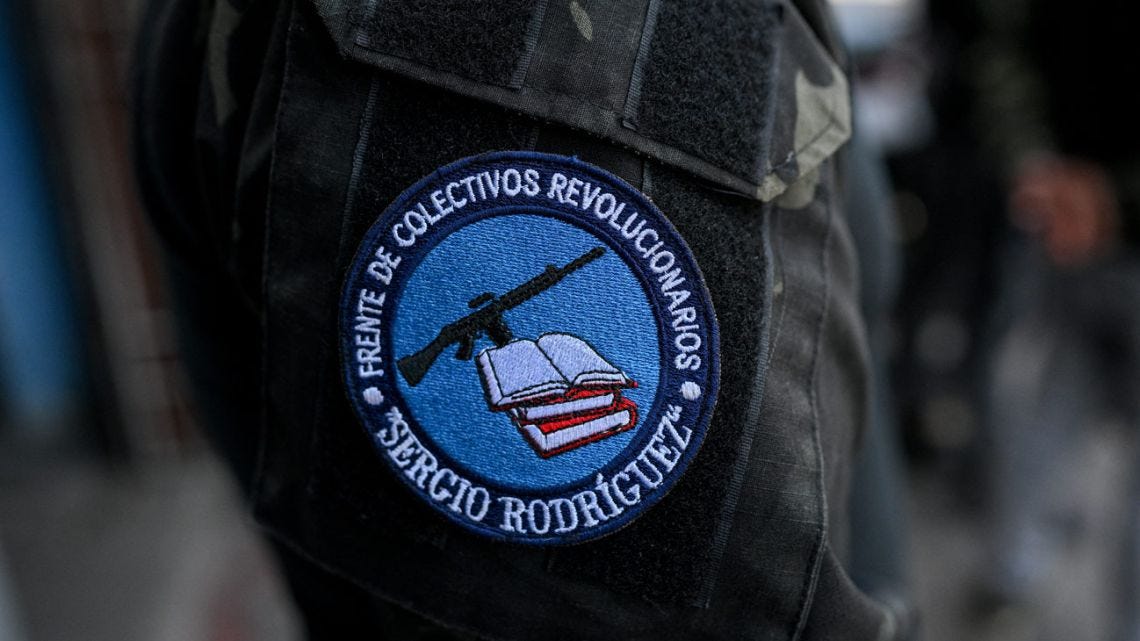
In Venezuela, the regime works through the colectivos. These are quasi-governmental paramilitary organizations, empowered to act independently and without oversight. They control day-to-day life, including distributing (or withholding) food rations supplied by the regime.
At different times, they meet both of the asylum criteria. They are:
direct actors on behalf of the government, and
groups that the government chooses not to control.
Since Delgado was persecuted by the colectivos, it would be ludicrous to apply the “state action” bar. But the court applied it anyway.
With no foundation, the court rejected everything known and in the record about the colectivos. Instead, it invented the idea that they are unconnected to the Venezuelan regime:
Each of these arguments inextricably depends on a clear connection between the colectivos and the Venezuelan regime or the Venezuelan regime's hostility toward him.
That’s a plain legal error. (Technically, the court applied this in the context of the Cabrera tests. But those tests repeatedly refer to “the persecutor”, which need not be the government itself. There’s no basis in Cabrera or elsewhere for requiring a “clear connection” to the regime.)
Delgado doesn’t have to show that the Venezuelan regime itself is hostile toward him. He only has to show that he was targeted by groups that the government is “unable or unwilling to control.”
(The colectivos are, at times, literal state actors, so I’d argue that their animus is sufficient to show hostility by the regime itself. But even if that weren’t the case, they are certainly actors that the regime is “unwilling to control”. That alone is sufficient.)
Nevertheless, the court held him to the higher standard, considering only persecution by the Venezuelan government itself:
The record does not suggest the Venezuelan government ever identified Delgado such that he would be targeted for persecution if he returned.
A new bar for “political opinion”
For there is none of you so mean and base
That hath not noble luster in your eyes.
Delgado’s persecution occurred because of his political work. He was shot while arranging transportation to the polls; he was tear-gassed at protests; he was menaced for wearing the party colors. Of course he was targeted for his political opinion.
But here the court again broke new ground. They invented de novo a rule that asylum for political opinion is limited to prominent politicians.
Although Delgado participated in some political activities over the years, the record evidence does not suggest that the Venezuelan government ever specifically identified him as an opposition leader, opposition politician, or significant opposition voice such that he would be targeted for persecution if returned to Venezuela.
This new test was introduced, almost as an aside, in the court’s “future persecution” analysis. It’s an unprecedented (but precedential) narrowing of asylum eligibility.
Of the five protected grounds for asylum, “political opinion” is hereby limited to just a handful of “significant” people from any given country.
A new requirement to acquiesce …
Farewell, good Salisbury, and good luck go with thee.
And yet I do thee wrong to mind thee of it,
For thou art framed of the firm truth of valor.
If Delgado returns to Venezuela, he will continue protesting. For the court, this is another point against him.
Delgado petitions this court for asylum based on harm he expects to experience by vowing to resume political activism against the Maduro regime if returned to Venezuela. Legitimizing such an argument would effectively enable any political dissident who opposes a regime antagonistic to its political opposition in their home country to qualify for asylum. Because this would unduly expand the scope of this extraordinary relief beyond what Congress contemplated, we emphatically reject it.
Let’s take a beat to admire the hypocrisy. Here’s a conservative court abandoning textualist principles to indulge in speculation about “legislative intent” and real-world policy consequences. Save us from activist judges! Nothing in the statute’s text authorizes the court to exclude Delgado’s intention to continue protesting from the risk assessment. From an originalist perspective, it must be considered.
Also, keep in mind that this isn’t just “any political dissident”. In general, a court could be forgiven for questioning a stated intention to risk one’s life for a cause. But here, Delgado’s steadfastness is not in doubt.
But “originalism” vs “pragmatism” aside, let’s think about what this means. The Court is telling asylum seekers that they must be prepared to abandon their principles. It’s telling them to give up.
Would they, for example, tell an Iranian Christian to abandon their religion, return to Iran, and live as a Muslim? And if not, how can they say to Delgado, “go home, abandon your fight, and accept your lot as the humble subject of a dictator?”
… And a new bar for those who fight on
Once more unto the breach, dear friends
All of this is pretty bad, but I saved the worst for the end.
The Court held that, because he kept going back to Venezuela, he couldn’t really have thought it was dangerous. They use his very courage to undermine both the fact of his past persecution and the probability of future persecution.
Delgado entered the United States twice after these incidents without filing an asylum application. Delgado did not believe he was being persecuted, nor did he fear future persecution at the time, evidenced by his continued participation in political protests.
Of course, there are situations in which this argument makes sense. Suppose, for example, that a wealthy White South African with important business interests had many chances to leave. Suppose that, over the course of years, he failed to seek asylum elsewhere, and instead returned repeatedly to South Africa to protect his investments. A court could be forgiven for questioning his fear of persecution.
That’s not what happened here.
Delgado’s motive for returning to Venezuela was ideological, not venal. It goes to the core of his claim. His political opinion — the basis on which he seeks asylum — compelled him to continue his work. He risked his life to stand up for his beliefs. His willingness to face danger because of his beliefs should strengthen his claim, not undermine it.
Recently, the administration authorized “Operation Absolute Resolve” to arrest Maduro. When the U.S. troops volunteered for this mission, they, like Delgado, put their lives in danger for the cause of a free Venezuela. Would the judges argue that the fact that they accepted the risk meant that the risk didn’t exist?
If we believe that the Delta Force bravely entered Venezuela despite the danger, then we must believe in the bravery of others, like Delgado, who made the same choice. If we honor the Delta Force members who were shot because of their opposition to Maduro, we must honor Delgado for being shot in the same cause.
https://scholar.google.com/scholar_case?case=4722792214203191669
"No-brainers" = a faster-spinning head. To "take a beat and admire the hypocrisy"? And the beat goes on.
I am constantly impressed by your research and skill in bringing these stories to light. My fear is that we (a lot of us) are all feeling so beaten down (albeit the first-world variation). Keep sharing the personal stories. Keep humanizing humans.