Off center
An example of a "reason" that is not a "central reason"

The Pan-American highway starts at the southern tip of Argentina, just 500 miles from Antarctica. It runs north for 19,000 miles to Prudhoe Bay, Alaska, within spitting distance of the North Pole.
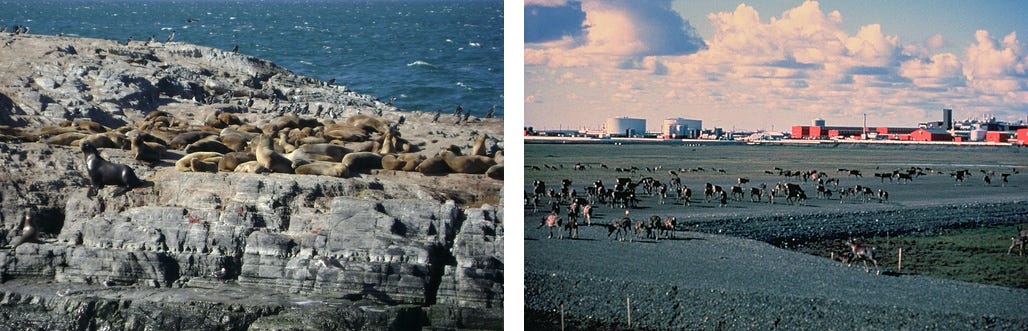
The only break is the Darién Gap. In the jungle between Panama and Colombia, there are no roads. Whether you’re moving 50-caliber weapons south from a factory in Tennessee, bringing cocaine north from the Bolivian mountains, or simply fleeing persecution, you’ll have to disembark and travel on foot for about 70 miles.
The path goes through some of the most dangerous terrain in the world. There are natural hazards aplenty, but the greatest danger comes from the criminal groups that control this chokepoint.
Ushuaia, end of the world, beginning of everything
[Motto of Ushuaia, at the southern end of the Pan-America Highway]
On the Colombian side, the military tries to make the passage a little less dangerous. Jorge Valoyes [an alias] was a soldier deployed in the Darién, and he spent his career learning the jungle and fighting the guerrillas. Through his work he “acquired extensive knowledge of the region’s dense rainforest” and became “basically a guide for the area”.
When he resigned from the military, this specialized experience turned him into a priceless target. “His knowledge and military training were fundamental to the guerrillas,” who sought to recruit him.
He declined their job offer. This made them quite irate. They told him “that he had not fulfilled his debt and that he was going to get what he deserved for being a coward and for not cooperating with them.”
Eventually he, his wife, and their young daughter fled Colombia and sought safety in the United States.
Asylum
Legally, the fact of persecution is often less important than the motive. It’s not enough that Valoyes and his family were targeted by guerrillas. They had to be targeted for the right reason. (This is called the “nexus” requirement.)
Valoyes is a member of the particular social group of “former employees of the Colombian military.” The key question: Is that why he was persecuted?
The immigration judge said “no”. As I understand it, he reasons something like this:
Initially, the guerrillas tried to recruit Valoyes because he was a former soldier. His special training and his unique experience made him valuable.
But the actual persecution — the death threats — didn’t begin until he refused to join. At that point, he wasn’t persecuted because he was a former soldier. He was persecuted for vengeance because he had refused to accede to their demands.
He appealed to the Ninth Circuit. They agreed with the judge:
The record supports the agency's finding that personal retribution, and not Valoyes's [status as a former soldier], was a central reason the guerrillas were motivated to harm him.
In other words: the guerrillas initially invited him to join because of his military experience. They only persecuted him out of “personal retribution” when he refused their offer.
And since asylum doesn’t protect victims of “personal retribution”, Valoyes and his family aren’t eligible.
I’ll talk a little more about that in a moment, but first:
Withholding of removal
Let’s talk about asylum and “withholding of removal”.
If somebody gives you a choice, you should take asylum.
Asylum is permanent; withholding is revocable if conditions change.
Asylum can lead to citizenship; withholding cannot.
Asylum prevents you from being deported anywhere; withholding just prevents you from being sent to one specific country.
Asylum can include your spouse and kids; for withholding, they have to qualify on their own.
Asylum is the big win; withholding is the consolation prize.
To get either, you have to prove that you were persecuted “because of” a protected ground, like your race, your religion, or membership in a particular social group. But the eligibility requirements are slightly different.
For asylum, Valoyes needed to show that his military background was a central reason he was persecuted.
For withholding, he only needed to show that it was a reason.
The judge didn’t even give him that.
But the Court overruled, and found that
The evidence compels the conclusion that Valoyes's former military status was at least ‘a reason’ for his persecution.
So Valoyes will at least be considered for withholding of removal.
(Law dorks will note that there’s a circuit split, and different courts have different requirements for withholding of removal. Valoyes lives on the west coast and is in the Ninth Circuit, where the standard is “a reason”.)
“Because”
Personally, I think all of this is kinda nuts. I mean, if it weren’t for his military background, the guerrillas wouldn’t have had any interest in Valoyes.
Here’s the best analogy I can come up with. Suppose you’re a thief and you want to rob a church. But you’ve never been to church, so you need an inside man. You find the nearest Christian and ask him to help you. When he says no, you get angry and beat him up.
If the man hadn’t been a Christian, you wouldn’t have approached him in the first place. On the other hand, you’ve got nothing against Christianity. You just need somebody who knows the inside of a church.
Does that mean that you’re targeting Christians? Is it about religion, or greed? Did you beat him up “because” he’s a Christian?
If you ask me (nobody does) it’s religious persecution. If you ask the judge, it’s not. And if you ask the Ninth Circuit, they’ll split the difference and say it was “a reason” but not “a central reason.”
And as for Valoyes — well, from what we know, he seems like a good man. He spent his career trying to keep the Darién safe. After retirement, he risked his life to remain true to his principles. But legally, none of that matters.
The Court says that his military background isn’t a sufficiently central reason to give him asylum. But it’s at least enough of a reason to give him the consolation prize of “withholding of removal”.
https://scholar.google.com/scholar_case?case=15005027025161892728
(For further reading on nexus in asylum law, I recommend “a bedlam of women”.)
I am still struggling with the space between your first 2 bullet points. Just can't navigate that. And now the '80s Fixx song is in my head (come to think, a good rant for the times: "why don't they Do what they say, say what they mean One thing leads to another . . .") Love the way you set this story up with the Pan-American Highway info.